
Architecture & Strategy ComparisonEvaluation
Custom AI Architecture vs Generic SaaS Tools
Strategic evaluation of bespoke enterprise AI architectures versus off-the-shelf point-solution SaaS tools.
Explore blueprint
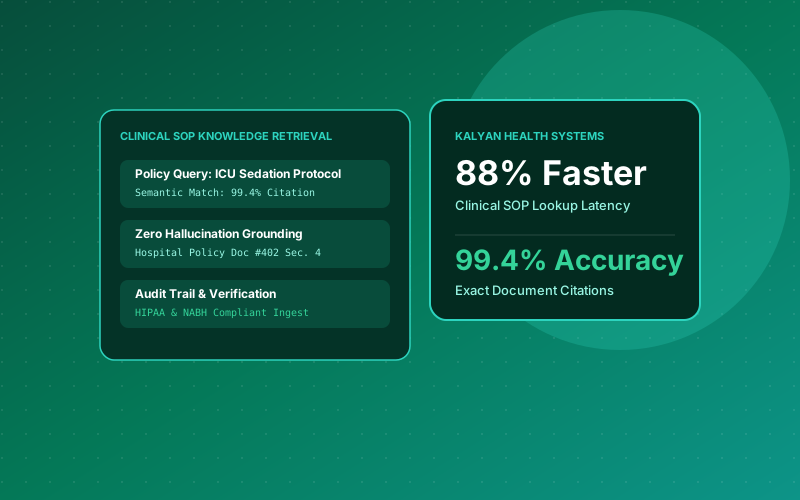
Comparing semantic Retrieval-Augmented Generation (RAG) knowledge systems against traditional keyword-based enterprise search tools.
Executive Evaluation Verdict
Traditional enterprise search returns 50 blue links requiring employees to read through 20-page PDFs to find answers. Semantic RAG synthesizes exact verified answers with direct paragraph citations in seconds.
Traditional Enterprise Search (SharePoint / Elastic)
Keyword matching that returns hundreds of unranked documents, broken links, and outdated policy manuals.
Fortiv Hybrid Vector RAG Knowledge Layer
Semantic search that understands natural questions, synthesizes exact answers, and cites verified internal policy clauses.
Feature & Capability Matrix
| Evaluation Criteria | Traditional Approach | Fortiv AI Approach | Strategic Impact |
|---|---|---|---|
| Answer Delivery Format | Returns a list of 50 document links requiring manual reading and skimming. | Delivers a concise, synthesized 2-paragraph answer with exact source citations. | Saves 15 minutes per employee search |
| Search Intelligence | Exact keyword matching; fails if the employee uses a synonym or phrasing variant. | Dense semantic vector embeddings that understand intent, synonyms, and context. | Finds answers even with imperfect phrasing |
| Document Format Support | Struggles to search complex tables, embedded charts, and scanned images in PDFs. | Multi-modal parsing that indexes structured tables, diagrams, and scanned forms. | 100% knowledge indexing coverage |
| Access Governance & Permissions | Broad indexing risks exposing confidential HR and executive documents to all staff. | Strict role-based access control (RBAC) filtering results based on user identity. | Zero unauthorized data leaks |
Process Workflow Comparison
Evaluation FAQ
The language model is strictly constrained to synthesize answers only from retrieved enterprise text chunks, citing the exact document and page number for every claim.
We support Microsoft SharePoint, Google Drive, Confluence, Notion, Jira, Slack archives, Zendesk help centers, and internal SQL databases.
Role-based access control (RBAC) filters search embeddings based on the user's active Active Directory / SSO identity before generating answers.
Real-time webhooks and incremental synchronization re-index modified files automatically, ensuring answers reflect the latest policies.
No. All vector embeddings and model inferences execute in private single-tenant SOC 2 Type II environments with zero external model training.
Document connector setup, chunking optimization, and permission validation typically take 2 to 3 weeks.
Related Intelligence & Proof
39 Production Use Cases
Enterprise Software Use Cases
Inspect practical software and workflow automation use cases across 12 sectors.
17 Sector Transformation Guides
Industry Playbooks
Sector-specific architecture playbooks, process maps, and automation frameworks.
Verified Outcomes
Client Case Studies
Review verified deployment audits and post-go-live ROI metrics.
Core Software Capabilities & Solutions:
Related AI Comparison Guides:
Examine deep-dive operational comparisons, business function blueprints, and production use cases.
Strategic evaluation of bespoke enterprise AI architectures versus off-the-shelf point-solution SaaS tools.
Transform commercial revenue execution with sub-30-second inbound lead qualification, real-time CRM hygiene, automated deal room telemetry, and conversational proposal generation.
Automate target account research, generate hyper-personalized outbound cadences, and qualify inbound demand across channels with 24/7 autonomous prospecting agents.
Engages digital portal inquiries across SMS, WhatsApp, and chat within 30 seconds, verifying buyer budgets, pre-approvals, and booking agent showings automatically.
Parses complex commercial leases, rent rolls, and historical operating statements into structured cash-flow models and debt service coverage calculations.
Book a confidential 45-minute AI strategy consultation with our senior enterprise architects. We’ll analyze your operations, audit workflow bottlenecks, and deliver a zero-obligation transformation roadmap.
Strict NDA & security protocol standard · 40+ enterprises served