

AI Voice Agents
AI voice agents that answer, qualify and route calls — and log every one.
AI voice agents resolve routine customer requests, qualify leads and hand complex calls to your team with the full transcript. Conversational voice AI for inbound and outbound lines, connected to your CRM.
What a voice agent connects to
The call
- Inbound and outbound calls
- Twilio, SIP trunks or your contact-centre platform
The agent
- Understands natural, interruptible speech
- Looks up the CRM and knowledge base
- Transfers to a person when needed
Writes back to
- Transcript and summary in the CRM
- Call outcomes for reporting
Illustrative. Scripts, voice and transfer rules are yours.
A request arrives
Inbound and outbound calls
The AI reads it
Understands natural, interruptible speech
The AI drafts the action
Looks up the CRM and knowledge base
A person approves
Defined triggers — signs of frustration, specific keywords, or a query the agent can't resolve — start a warm transfer to a person, along with the transcript so far.
The operational problem
Why traditional IVR phone trees frustrate callers
Traditional 'Press 1 for Support' phone trees frustrate callers, drive abandonment and put pressure on human agents. At the same time, scaling a call centre is expensive, slow and affected by turnover.
Where it breaks down
- 01Clunky, frustrating customer experiences with rigid phone trees
- 02High operational costs for level-1 support call centres
- 03Inability to scale voice support during unexpected traffic spikes
How it works
How we build a voice agent, from conversation design to a live line.
- 01
Voice persona and scripting
Design the agent's tone, personality and core conversational flows.
- 02
Knowledge base integration
Connect the voice agent to your knowledge systems and CRM for contextual answers.
- 03
Telephony setup
Integrate with Twilio, SIP trunks or existing contact-centre platforms (Genesys, Five9).
- 04
Latency optimisation
Tune speech-to-text and text-to-speech so responses come back quickly enough for natural conversation.
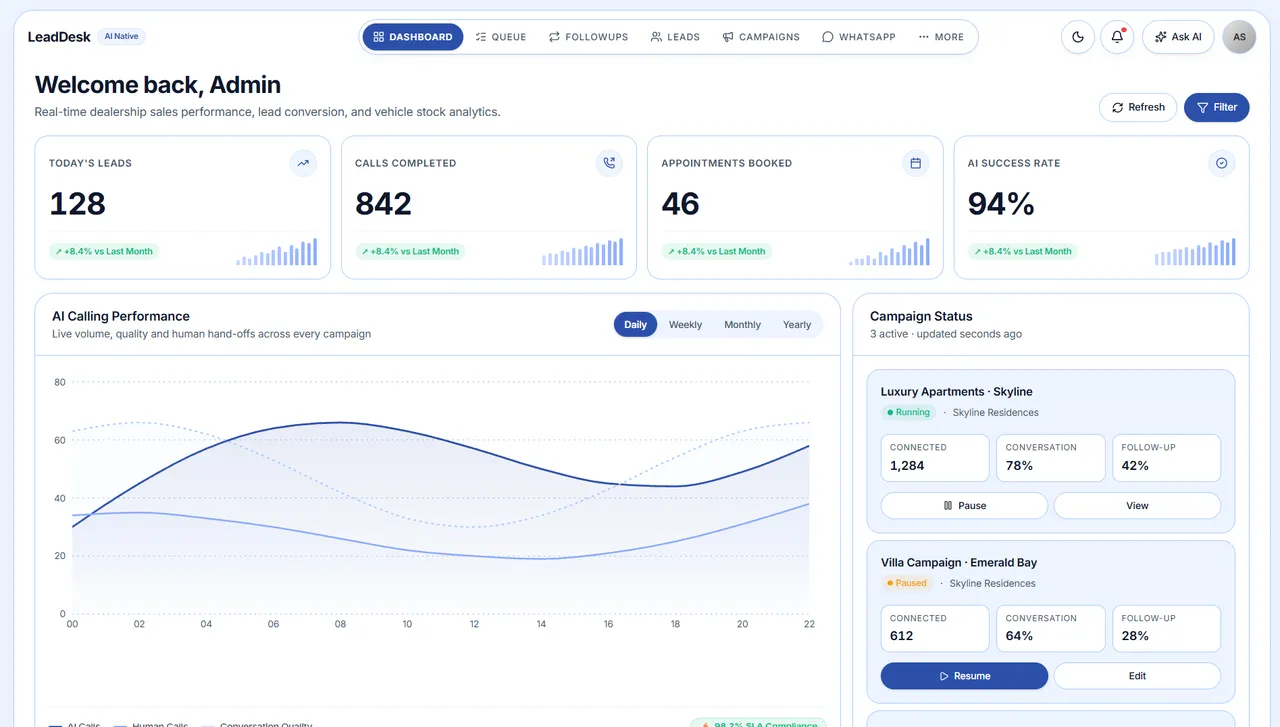
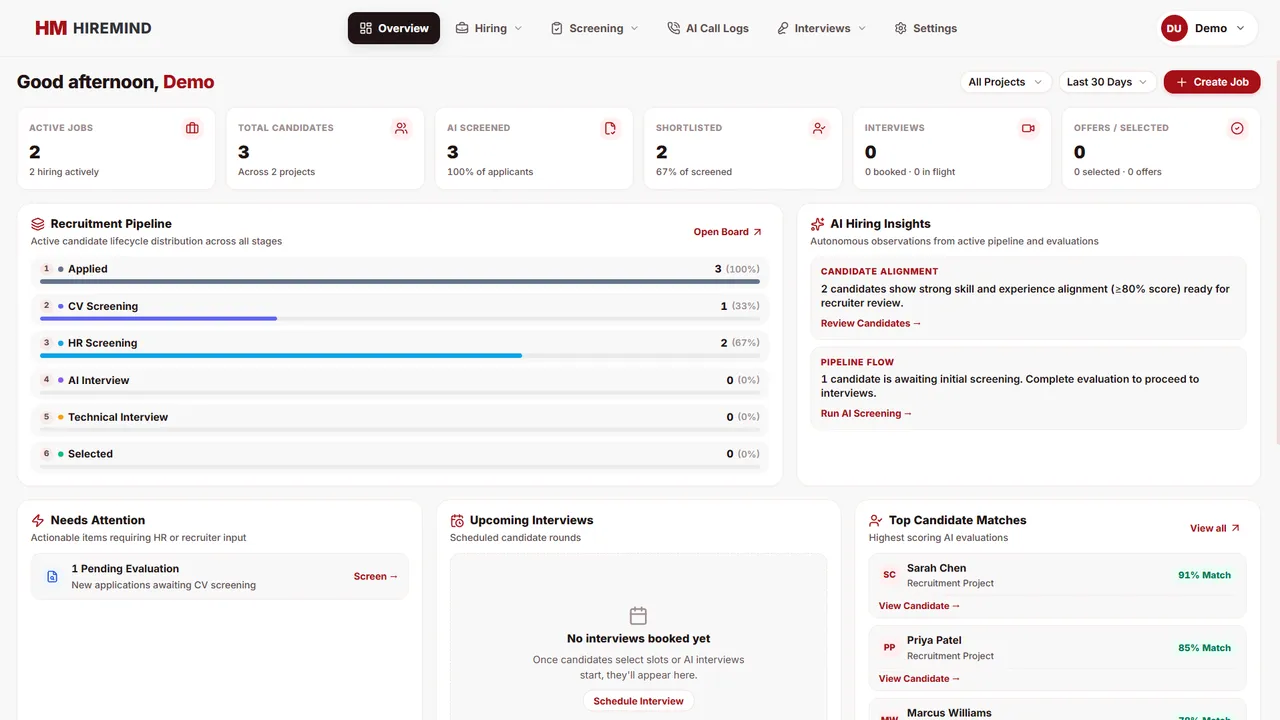
From the portfolio
What it looks like in a client project.
Screens from systems we built and run. Details are anonymised.
Capabilities
Voice AI conversations that hold up at volume.
Natural interaction
Natural, interruptible conversations designed around your scripts and tone of voice.
Capacity for peaks
Designed to take concurrent calls during traffic spikes, within the capacity of your telephony setup.
Lower cost per routine call
Routine level-1 calls handled without a queue, so your team spends its time on the complex ones.
What we deliver
Scope is agreed per engagement. These are the components a typical build includes.
- Custom voice agent deployment
- Telephony and SIP integrations
- Call analytics dashboard
- Call transcript and CRM syncing
- Latency and reliability optimisation
Integration & implementation
Voice agents connected to your telephony and CRM.
We connect through the APIs, webhooks and identity controls you already have, and agree data handling with your team before anything is built.
Your systems
- Twilio
- Genesys
- Five9
- Salesforce
- HubSpot
- Zoho CRM
- Zendesk
Fortiv layer
- Understands natural, interruptible speech
- Looks up the CRM and knowledge base
- Transfers to a person when needed
Low-confidence cases go to a person
What comes back
- Transcript and summary in the CRM
- Call outcomes for reporting
Systems are examples, not a fixed list.
Human review
Defined triggers — signs of frustration, specific keywords, or a query the agent can't resolve — start a warm transfer to a person, along with the transcript so far. Calls are transcribed so your team can review them.
Security and data handling
Access follows your existing permissions, actions are logged, and hosting, model providers and data retention are agreed with your security team — we work within your requirements. How we approach security
Industry applications
Where it applies.
Typical applications. Each is scoped against the workflows and systems of the organisation in question.
Telecommunications
Handling billing inquiries and troubleshooting network issues.
Healthcare
Appointment scheduling, reminders and triage routing.
Industry overview
Real estate
Inbound lead qualification and outbound property updates.
Industry overview
In practice
Measurement
What we measure.
We record a baseline for each of these before go-live and report against it. We don't quote results before we have seen your workflow and data.
Containment rate
Share of calls resolved without a person, by call type.
Response latency
Time from the caller finishing speaking to the agent replying.
Transfer quality
How often transfers reach the right person with usable context.
CRM completeness
Share of calls logged with transcript, summary and outcome.
AI voice agents are phone agents that hold a spoken conversation with a caller. They combine speech recognition, a language model and text-to-speech, and they look up your CRM and knowledge base during the call. They answer routine questions, collect details, book appointments and transfer the call to a person when it needs one.
The agent connects to your telephony through Twilio, SIP trunks or contact-centre platforms such as Genesys and Five9. Calls are routed to the agent by number, time of day or menu option. After each call, the transcript, summary and outcome are written back to your CRM so the record is complete.
Yes. Our voice agents support interruption handling. If a caller speaks over the agent, it stops talking, listens to the new input and adjusts its reply. We test this with real call scripts during the pilot, because natural turn-taking matters more to callers than the choice of voice.
No. We use current text-to-speech models, for example from ElevenLabs or Deepgram, with natural-sounding voices, pacing and pauses. You choose the voice, the tone and the script the agent works from. Callers are told they are speaking with an automated assistant where your policy or local rules require it.
Yes. We set specific triggers, such as signs of frustration, particular keywords or a question the agent cannot resolve, that start a warm transfer to a person. The person receives the transcript of the conversation so far, so the caller does not have to repeat themselves.
Cost depends on call volume, the number of call types, your telephony setup and the systems the agent must update. We agree scope after discovery and usually start with a pilot on the call types your team answers most. The pilot is measured against your current containment and handling baseline before any wider rollout.
Agents & automation
Related solutions
- AI agent developmentAutonomous AI agents that plan and carry out defined tasks through your enterprise APIs, with approval steps where you need them.
- AI workflow automationAI workflow automation for multi-step processes that reads unstructured inputs, acts across systems and routes low-confidence cases to people.
- All solutions
Further reading
- Use case · Real EstateReal Estate Voice AI for Outbound Lead Outreach & Stale CRM Re-Activation
- Use case · Law FirmsAI Legal Client Intake & Routing for Law Firms
- Use case · HealthcareVoice AI Patient Intake & Appointment Scheduling for Healthcare
- Business functionAI in Sales & Pipeline Acceleration
- Business functionAI in Customer Service & Support Operations
- Executive guideVoice AI for Customer Acquisition & Support