
AI Transformation
Preparing Your AI Experience
Loading System Engine0%
An institutional research report on how hospital systems and medical groups are reducing protocol lookup latency by 88%, eliminating call center hold times, and cutting insurance claim denials by 32% with zero clinical hardware.
Sector Economics & Scale
Healthcare providers face severe administrative labor strain, losing millions annually to insurance claim denials and patient referral leakage while clinicians spend hours navigating policy manuals.
$28.5B Healthcare AI Market
+36.2% CAGR
Strategic Shifts
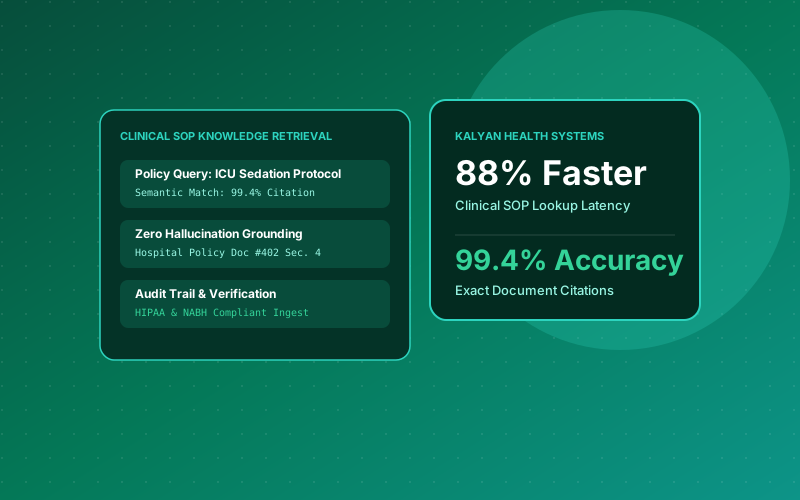
Hybrid vector search delivers exact verified medication titration rules from 4,000+ hospital SOPs directly to nursing terminals.
Conversational voice agents answer patient booking calls on the first ring, triaging urgency and writing into EHRs.
Machine learning audits 837 medical claims against commercial payer adjudication rules before submission.
Production Solutions
Problem: Clinicians spend valuable minutes searching disparate policy PDFs to verify medication protocols.
Solution: Hybrid semantic search delivers verified protocol answers with exact clause citations to bedside tablets.
Measured Outcome
88% faster protocol lookup latency and 99.4% citation accuracy.
Problem: Hospital call centers experience 20-minute wait times, causing patient abandonment.
Solution: 24/7 conversational Voice AI triages symptoms, verifies insurance, and writes appointments to EHRs.
Measured Outcome
Hold times cut to under 30s, bookings lifted by 45%, no-shows < 3%.
Problem: 15% of outgoing hospital claims are denied due to minor coding discrepancies and missing prior auths.
Solution: Pre-submission claim scrubbing evaluates CPT/ICD-10 combinations against commercial payer rules.
Measured Outcome
32% reduction in initial claim denials and -14 days in A/R.
Problem: 50% of patient referrals sent from primary care doctors are lost in unprocessed fax queues.
Solution: Automated referral fax OCR initiates patient outreach within 15 minutes to secure clinic bookings.
Measured Outcome
$340,000 recaptured in outpatient revenue in 90 days.
Deployment Roadmap
Report FAQ
Yes. All processing executes in dedicated single-tenant HIPAA-compliant environments with business associate agreements (BAA) and end-to-end encryption.
We connect natively with Epic Systems, Oracle Cerner, AthenaHealth, NextGen, eClinicalWorks, and Allscripts via SMART on FHIR.
It operates on strict retrieval-augmented guardrails: it only answers from verified hospital text, explicitly citing the exact SOP document and page.
It detects red-flag symptom keywords (chest pain, shortness of breath), advising the caller to dial 911 while initiating an urgent live transfer to triage nurses.
Yes. It cross-checks scheduling orders against payer prior authorization requirements, alerting clinic staff 5 days before scheduled procedures.
EHR integration, clinical protocol indexing, and staff training take 3 to 5 weeks with complete validation documentation.
Related Intelligence & Proof
39 Production Use Cases
Enterprise Software Use Cases
Inspect practical software and workflow automation use cases across 12 sectors.
12 Evaluation Guides
AI Comparisons
Architectural and process evaluations comparing AI vs legacy manual tools.
Verified Outcomes
Client Case Studies
Review verified deployment audits and post-go-live ROI metrics.
Core Software Capabilities & Solutions:
Explore Other Sector AI Research Reports:
Book a confidential 45-minute AI strategy consultation with our senior enterprise architects. We’ll analyze your operations, audit workflow bottlenecks, and deliver a zero-obligation transformation roadmap.
Strict NDA & security protocol standard · 40+ enterprises served