

Industry
How Slow Lead Follow-Ups Are Costing Real Estate Businesses Sales
Discover how slow lead follow-ups can cost real estate businesses valuable sales and how AI follow-up automation can improve lead engagement and conversions.
By Dhanesh Mahto, Founder & CEO of Fortiv Solutions · · 8 min read
Summary
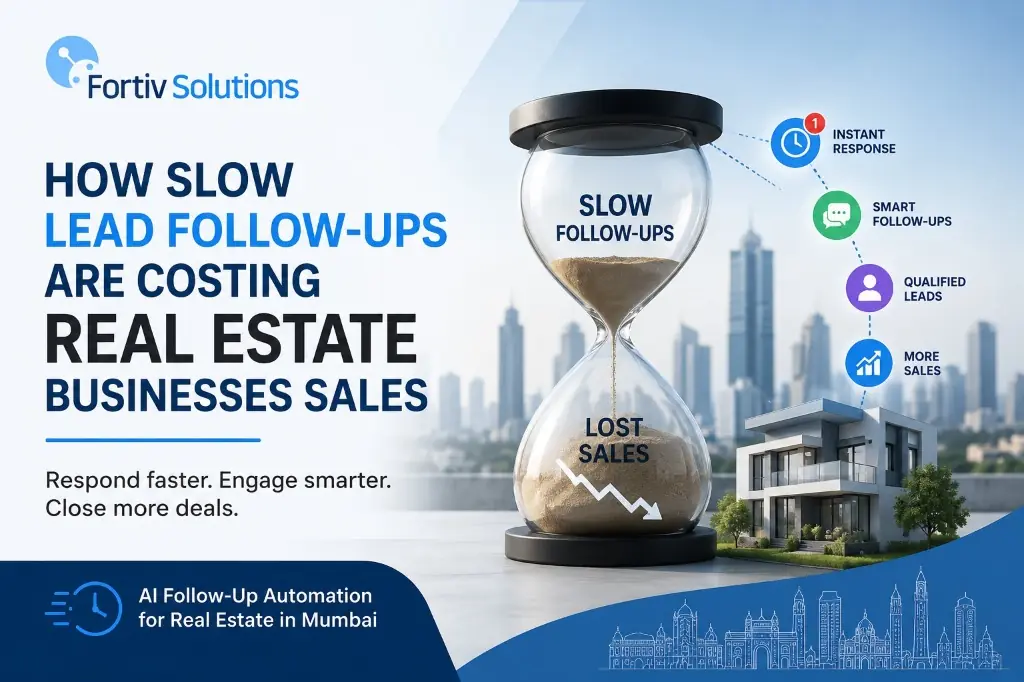
Real estate is a business where timing matters. A person enquiring about a property today may be speaking to several agents tomorrow. If the first response takes hours or even a day, there is a good chance that the prospect has already moved on to another property, agent, or developer. AI Follow-Up Automation enables real estate businesses in Mumbai and global markets to respond, qualify, nurture, and re-engage leads throughout the sales journey without overwhelming sales teams.
Key takeaways
- Inbound real estate enquiries express immediate interest; delayed follow-ups allow prospects to engage with competitors.
- Real estate sales require multiple touchpoints—consistent automated follow-ups keep the conversation alive across extended decision cycles.
- Managing follow-ups manually becomes difficult at scale as sales teams juggle site visits, calls, and hundreds of database leads.
- AI automation serves as a support layer for sales teams, maintaining consistency while salespeople focus on high-intent consultations and closing deals.
The challenge
Real estate businesses invest heavily in Google Ads, Meta Ads, property portals, and social media to generate lead volume. However, generating an enquiry does not guarantee a sale. When follow-ups are delayed—such as an enquiry made during a lunch break remaining uncontacted until the next morning—prospective buyers lose interest or select competitors. Slow follow-ups create bottlenecks that lower lead engagement, reduce site visits, and decrease marketing ROI.
Industry and governance context
Mumbai's real estate market is highly competitive, with buyers and investors comparing multiple property options online before speaking to a sales representative. Property decisions involve pricing, location, amenities, financing, possession dates, documentation, and physical site visits. Having a structured system to engage every enquiry promptly is critical to preventing high-intent leads from becoming inactive.
How it works
Why Speed to Response Matters: A real estate enquiry is an expression of immediate interest. When a sales team responds quickly, the conversation is fresh in the prospect's mind. Delayed responses mean the prospect may already have spoken with competing developers or brokers.
Automated Personalisation at Scale: AI systems use lead data and prior conversation history to tailor communications. A prospect interested in a two-bedroom apartment receives floor plans and pricing details, while someone inquiring about commercial real estate receives relevant yield metrics.
From First Enquiry to Site Visit: Automated follow-up workflows maintain continuous communication between initial contact and physical site visits. Prospects who are not ready to visit immediately remain engaged with relevant updates until they are prepared for direct sales consultations.
Figures discussed
| Measure | Figure | Context |
|---|---|---|
| Initial Response Speed | < 1 min | Instant automated acknowledgment across all channels |
| Lead Re-Engagement Rate | 3.4x | Higher prospect retention over multi-week decision cycles |
| Site Visit Conversion | +28% | Lift from structured automated follow-up journeys |
Illustrative figures
These figures describe what the approach in this article is typically designed to achieve. They are not measured results from a specific Fortiv engagement, and outcomes vary with data, systems and process.
Implementation roadmap
- Phase 1: Lead Journey Audit. Analyze existing inquiry channels, response lag times, and drop-off points in the current sales process.
- Phase 2: Workflow & Communication Design. Define automated follow-up sequences based on buyer intent, budget, property type, and previous engagement.
- Phase 3: CRM & Lead Source Integration. Connect property portals, website forms, Meta Ads, and WhatsApp channels to a unified CRM database.
- Phase 4: Sales Handoff Calibration. Set intent-based triggers so high-intent prospects are automatically escalated to human sales representatives for site visits and negotiations.
Common mistakes and practices that hold up
Common mistakes
- Assuming a lead is lost if the prospect does not respond to the first phone call or email.
- Relying entirely on manual memory to track follow-up schedules across large lead databases.
- Sending generic, unpersonalized broadcast messages that fail to account for property preferences.
- Viewing AI as a replacement for human salespeople rather than an operational support layer.
Practices that hold up
- Combine instant AI-powered follow-up automation with human expertise for high-stakes closing conversations.
- Segment follow-up communications based on property type, budget range, and demonstrated buyer intent.
- Keep prospects engaged with useful, relevant property insights during extended decision-making periods.
- Audit lead quality and communication logic regularly to ensure seamless handoffs between automation and sales reps.
Frequently asked questions
AI follow-up automation uses artificial intelligence and automated workflows to communicate with real estate leads after they submit an enquiry. Depending on the system, it can help with responses, lead qualification, follow-up reminders, nurturing and identifying prospects that require attention from a salesperson.
Yes. AI-powered systems can be configured to initiate follow-ups based on predefined timing, lead information and engagement. The exact capabilities depend on the automation platform and how it is integrated with the company's CRM and lead sources.
No. AI follow-up is generally most effective when used to support sales teams rather than replace them. Automation can manage repetitive communication, while sales professionals handle property consultations, negotiations, site visits and closing discussions.
AI cannot guarantee sales, but it can help improve the consistency and speed of lead engagement. By reducing missed follow-ups and helping sales teams prioritise engaged prospects, AI can potentially improve the efficiency of the overall sales process.
Fortiv Solutions can help real estate businesses evaluate their existing lead management process and identify opportunities for AI-powered automation. The approach can include understanding lead sources, designing follow-up workflows and connecting automation with the sales process so that human teams can focus on qualified opportunities.